Training Management
Training Management System within the Green Codes platform provides a complete digital solution for planning, executing, and monitoring training programs efficiently.
It starts with identifying training needs, followed by scheduling courses and assigning employees, and ends with evaluating performance and measuring training outcomes.
The system allows organizations to easily track employee attendance, participation, certifications, and overall progress through both the web platform and mobile application, helping improve workforce competency and operational readiness.
It also supports linking training programs to job roles, compliance requirements, and competency matrices, ensuring that employees receive the right training at the right time to maintain safety standards and professional development.
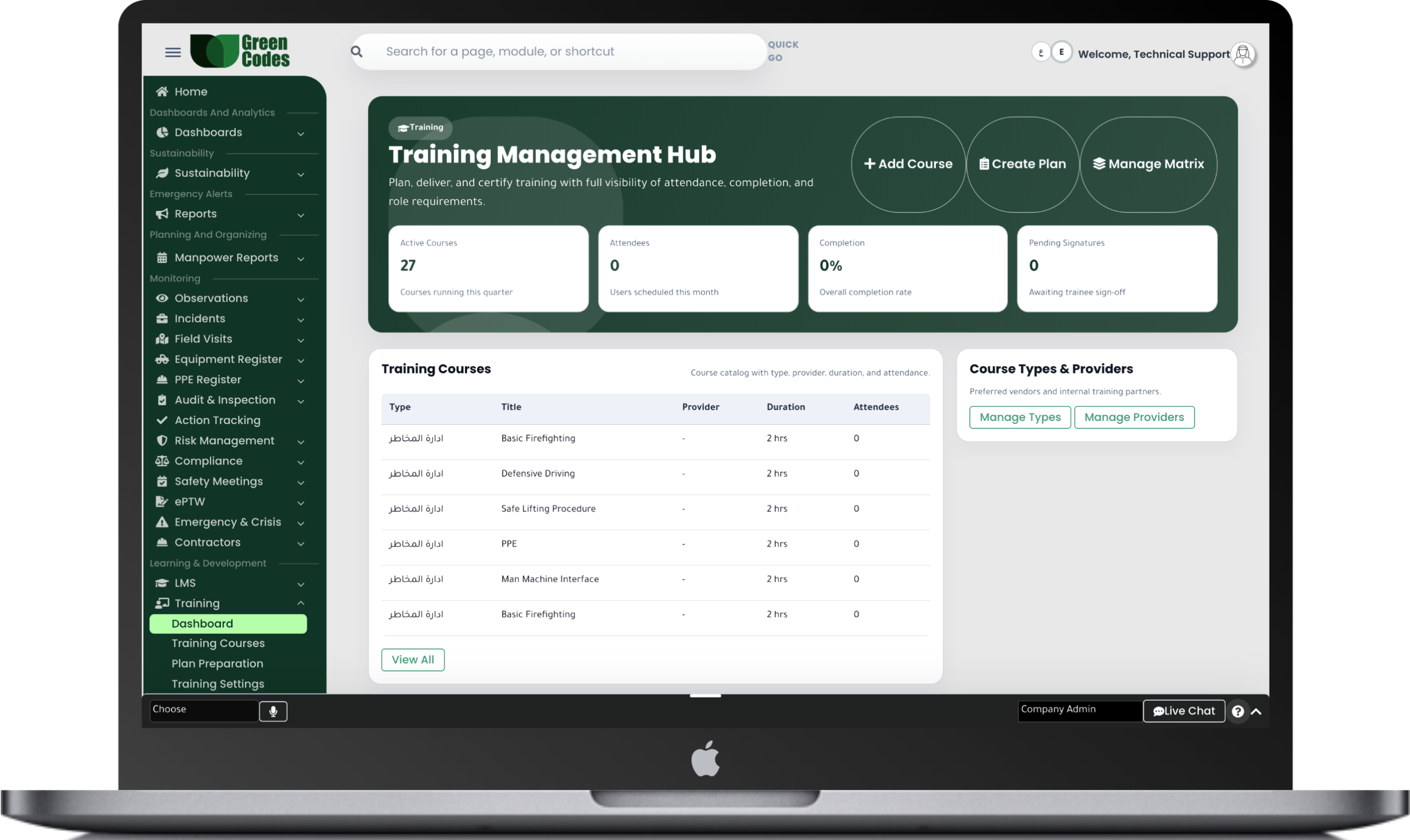
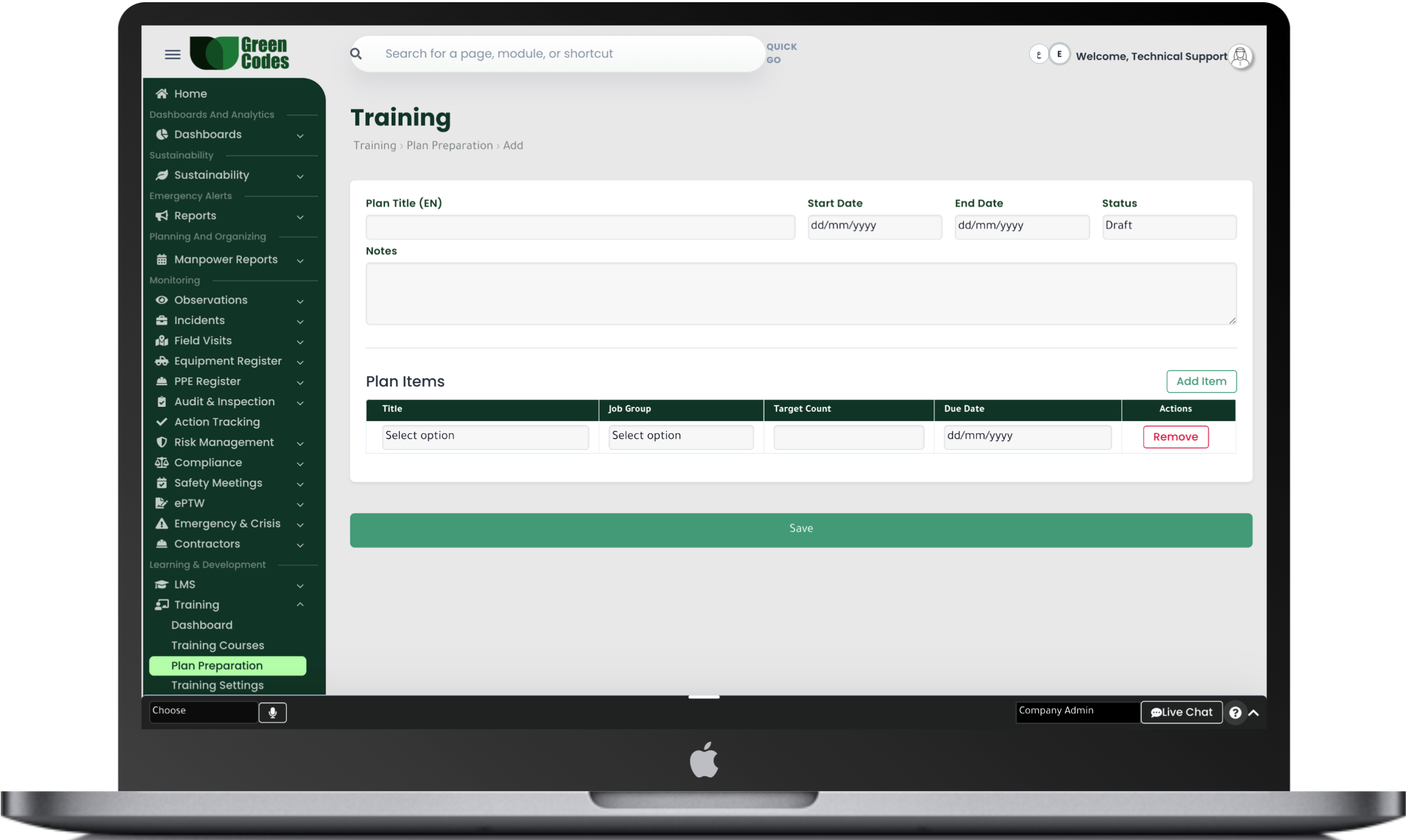
The Training Management System within the Green Codes platform provides a complete digital solution for planning, organizing, and monitoring all training programs and workshops efficiently. It starts with identifying training needs for employees and contractors, followed by scheduling courses and registering participants, and ends with evaluating results and measuring competency levels.
The system allows organizations to manage all training activities easily through the web platform or mobile application, helping improve awareness levels and professional competency within the work environment.
It also supports creating annual training plans linked to job roles, safety requirements, and compliance standards, with attendance registration, training material uploads, and certificate issuance, helping build a continuous learning culture inside the organization.
The system provides a complete set of reports and interactive dashboards that help monitor all training activities, such as reports for the number of completed courses, attendance and absence rates, test results, and training hours for each employee or team.
It also provides detailed reports on expired or soon-to-expire certifications, as well as competency and development performance indicators, helping management measure training impact and improve future development plans.
The system follows a clear workflow that starts with creating the training plan and identifying the target group, followed by scheduling the course and sending invitations to participants. After the training is completed, attendance and results are recorded, then certificates are issued, and training records are maintained for each user.
The system also supports automatic reminders for upcoming courses or certificates that require renewal.
Plan Creation ← Course Scheduling ← Invitations ← Execution ← Evaluation ← Certificate Issuance
- Annual training plans
- Attendance and absence registration
- Test and assessment results
- Electronic certificates
- Certificate renewal alerts
- Role-based training linkage
- Training hours reports
- Employee competency tracking
Frequently Asked Questions (FAQ)
What is the difference between Training Management and an e-Learning System (LMS)?
Training Management focuses on planning, scheduling, registration, and attendance for in-person training, workshops, or Toolbox Talks. An LMS, however, focuses on delivering digital content and tracking remote progress and exams. Many organizations use both simultaneously to achieve full coverage between field-based training and self-paced digital learning.
How does the system help build a training matrix based on job roles and risks?
Training can be linked directly to specific job roles (e.g., Scaffolding Supervisor, Crane Operator, Fire Watch) and their associated risks. The system displays required vs. completed training and identifies current gaps for every employee or contractor. This ensures competency requirements are met before executing high-risk tasks, aligning with modern safety system standards.
Can the system handle course scheduling, registration, and attendance?
Yes. You can create a course, set the date, location, and trainer, then invite participants and manage waiting lists. Post-execution, you can record attendance, attach training materials, and log assessment results. The system also supports issuing electronic attendance certificates linked directly to the trainee’s profile.
How does the system handle certificates that require renewal (e.g., First Aid or Lifting)?
You can input issuance and expiry dates and activate automated alerts for a set period before expiration. This prevents personnel from entering sites with expired credentials, reducing violations in projects with strict compliance requirements. It also generates reports identifying employees who need recertification soon.
Does the system support training requirements for the healthcare sector, such as Infection Control?
The system can be configured for mandatory healthcare programs, such as annual infection control training or new hire orientation within specific timeframes. It documents attendance and proves competency linked to internal licensing, supporting national healthcare education standards for practitioners.
How does the system measure training effectiveness rather than just hours?
Training can be linked to performance indicators like exam results, trainer feedback, or improvements in field inspection results post-training. You can compare violation or accident rates before and after specific programs to measure impact. This approach helps management invest in high-impact training rather than just “check-the-box” sessions.
Can contractor training be managed within the same system?
Yes. Since a significant portion of risk in construction projects stems from contractors, you can add contractor personnel and assign mandatory courses to them. Training can be linked to site access permissions or the issuance of work permits, ensuring that only qualified individuals perform high-risk work.
What reports are available to support decision-making in training management?
The system provides completion rate reports by project or department, training gap analysis by job role, and expiration reports for certificates. You can also generate reports on total training hours per employee/contractor and effectiveness metrics. These reports streamline annual planning and simplify proving compliance to clients or regulatory bodies.