Risk Management
An integrated platform for identifying risks, assessing them, and proactively tracking the necessary actions to minimize them.
The Risk Management System within the Green Codes platform provides a complete digital solution for identifying, assessing, and monitoring all types of operational, environmental, occupational health, and safety risks with high efficiency. It starts with recording potential risks and classifying them based on activities and locations, followed by evaluating the level of risk using probability and impact matrices, and ending with creating control plans, preventive actions, and monitoring their implementation.
The system allows organizations to register risks easily through the web platform or mobile application, with the ability to link each risk to its related location or activity, and attach photos, notes, and supporting documents. This helps improve assessment accuracy and accelerate response to potential risks.
It also supports instant reporting and interactive dashboards that help analyze risk levels, identify high-priority areas or activities, and monitor performance indicators related to mitigation plans. This enables decision-makers to take proactive actions to reduce incidents, losses, and continuously improve the work environment.
This comes within the framework of supporting compliance with approved regulations and standards, strengthening a proactive risk management culture, and raising safety and compliance levels across institutions and projects.
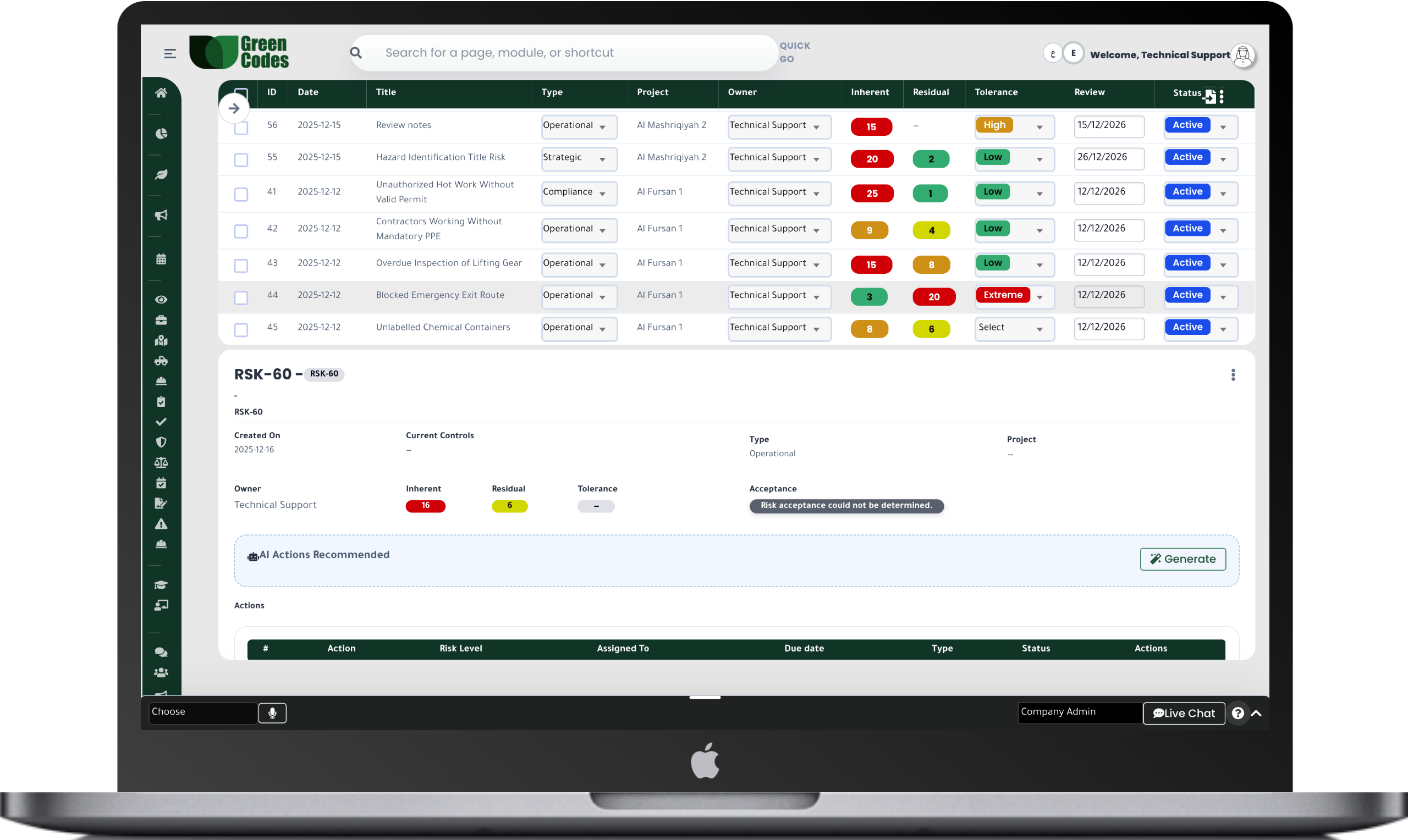
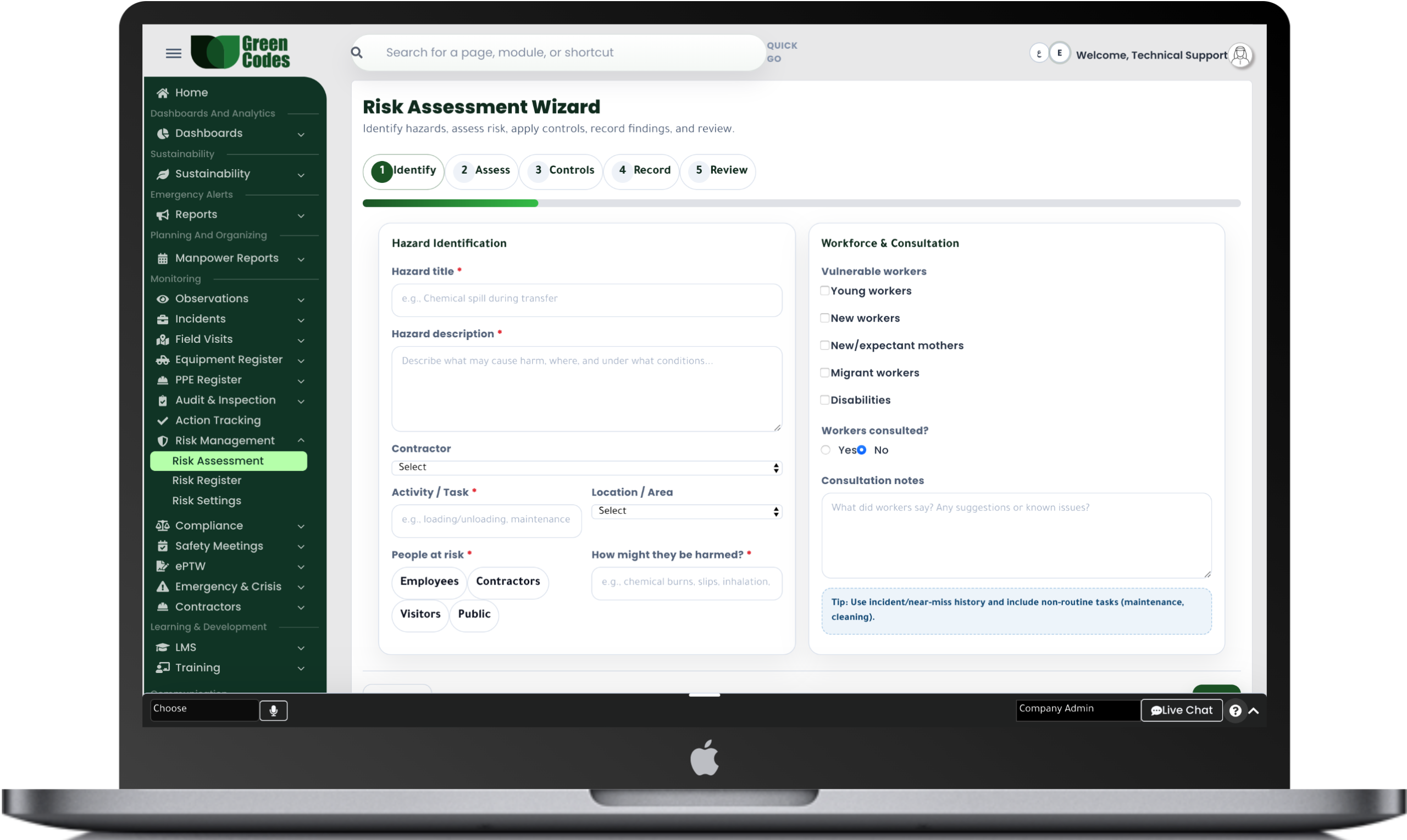
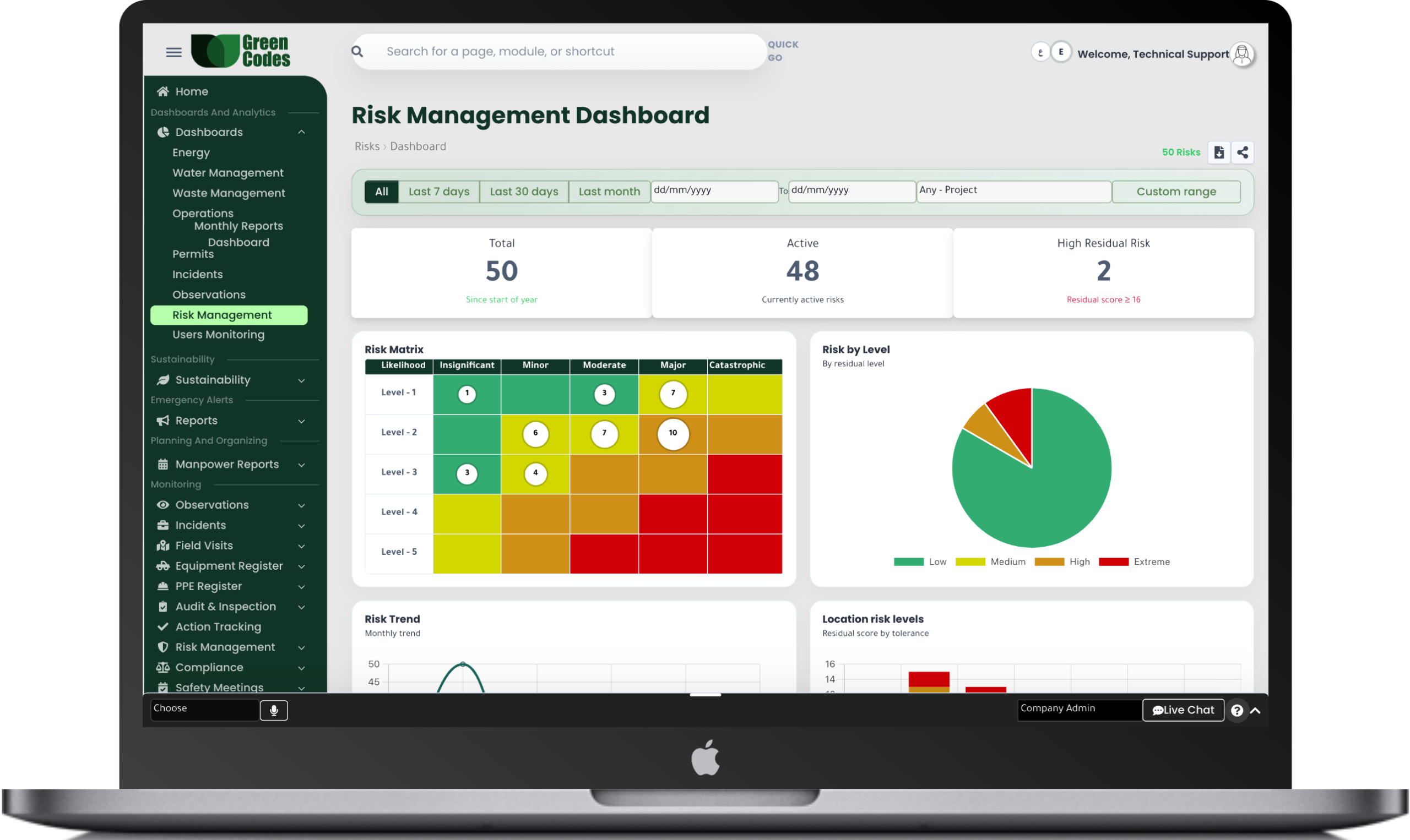
The Risk Management System within the Green Codes platform provides a complete digital solution for identifying, assessing, and monitoring all types of operational risks, safety risks, and occupational health risks with high efficiency.
It starts with recording potential risks and linking them to projects, locations, or activities, followed by evaluating the risk level using probability and impact matrices, and ending with implementing control plans, preventive actions, and monitoring their effectiveness.
The system allows organizations to manage risks easily through the web platform or mobile application, helping reduce incidents, losses, and improve operational readiness.
It also supports classifying risks by type and priority level, with the ability to link them to corrective actions, observations, and inspections, helping management make proactive decisions based on accurate data and clear analysis.
The system provides a complete set of reports and interactive dashboards that help analyze risks and monitor risk levels, such as risk matrix reports, high-risk areas, open risks, and mitigation plan completion rates.
It also offers executive reports that help management analyze trends and compare risk levels across projects or departments, enabling decision-makers to improve preventive plans and reduce the probability of incidents and losses.
The system follows a clear workflow starting with registering the risk and linking it to the related location or activity, followed by evaluating the risk level using the probability and impact matrix.
After that, a treatment plan or preventive action is created, the responsible person is assigned, implementation is monitored, and the risk is reassessed before final closure.
The system also supports periodic risk reviews to ensure assessments remain updated according to operational changes.
Risk Registration → Assessment → Treatment Plan → Implementation → Review → Closure
- Risk assessment matrix
- Priority-based classification
- Treatment plans and preventive actions
- Heat Map reports
- Periodic reviews
- Project and activity linking
- KPI dashboards
- Incident and loss reduction
Frequently Asked Questions (FAQ)
What is meant by a Risk Register?
A Risk Register is a centralized repository of potential risks associated with projects, activities, or locations. It includes a description of the hazard, its causes, potential consequences, and existing controls. Maintaining a single register reduces duplication of effort and ensures risk assessments remain consistent across different departments. It also allows for tracking the “Owner” responsible for each risk, the treatment plan, and results of periodic reviews.
How is the risk level assessed using a Probability and Impact matrix?
Risk levels are typically determined by identifying the likelihood of a hazard occurring and its impact (injury, downtime, financial loss, or environmental impact). The risk score is then calculated using a standard matrix. This matrix can be configured to match your organization’s specific criteria or client requirements by adding custom classifications or escalation thresholds. The results help prioritize resources toward risks that require higher-level approvals or additional controls.
Can risks be linked to specific activities like lifting, excavation, or work at height?
Yes. Linking a risk to a specific activity, task, or location avoids over-generalization. This makes it easier to translate a recorded risk into practical controls within Job Safety Analysis (JSA) forms, Permits to Work (PTW), or Standard Operating Procedures (SOPs). It also provides more accurate tracking of control effectiveness for high-risk recurring activities.
How does the system support control methodologies like the Hierarchy of Controls?
Proposed controls can be documented according to the logical sequence: Elimination, Substitution, Engineering Controls, Administrative Controls, and finally, Personal Protective Equipment (PPE). This reduces over-reliance on PPE as a standalone solution and encourages fundamental risk control. Each control can be linked to an executive action and a performance indicator to evaluate its effectiveness over time.
How are risk treatment plans managed and monitored?
Once a risk level is identified, a treatment plan is created, specifying the required action, the person responsible, the target date, and necessary resources. The implementation status is displayed on a risk monitoring dashboard, and escalations can be triggered for delays or for risks that remain at a high level. Upon closure, the risk can be re-evaluated to document the “Residual Risk” level after controls are applied.
Does the system support periodic risk reviews and Management of Change (MOC)?
Yes. Since risks change as the scope of work, equipment, or contractors change, you can schedule periodic reviews linked to inspections or safety meetings. A Change Log can be opened to document what changed, who approved it, and its impact on the risk profile. This is vital for long-term projects where operational interfaces and plans frequently evolve.
How can the Heat Map and risk reports benefit Senior Management?
The Heat Map provides a visual distribution of risks based on severity and probability, allowing management to quickly identify “hot spots” across a project or entire portfolio. Comparative reports between projects or contractors help direct resources to the highest-risk areas. This supports data-driven budgeting for controls that increase the likelihood of achieving objectives while minimizing losses—a core principle of modern risk management guidelines.
What is the relationship between Risk Management, Incidents, Observations, and Audits?
Risk management becomes significantly more accurate when fed by real-world data from incidents, observations, and inspection results, as these reveal actual gaps in controls. Any incident or nonconformity can be linked to an existing risk or used to generate a new risk entry if a recurring pattern emerges. Conversely, targeted inspection or training plans can be derived directly from priority risks identified in the register.