Compliance Management
An integrated platform for monitoring compliance with regulations, policies, and approved standards while promoting best practices.
The Compliance Management System within the Green Codes platform provides a complete digital solution for monitoring compliance with regulations, policies, and approved standards, starting from recording regulatory requirements, followed by tracking compliance status, and ending with implementing corrective actions.
The system also supports instant reports and interactive dashboards that help improve compliance levels and strengthen corporate governance.
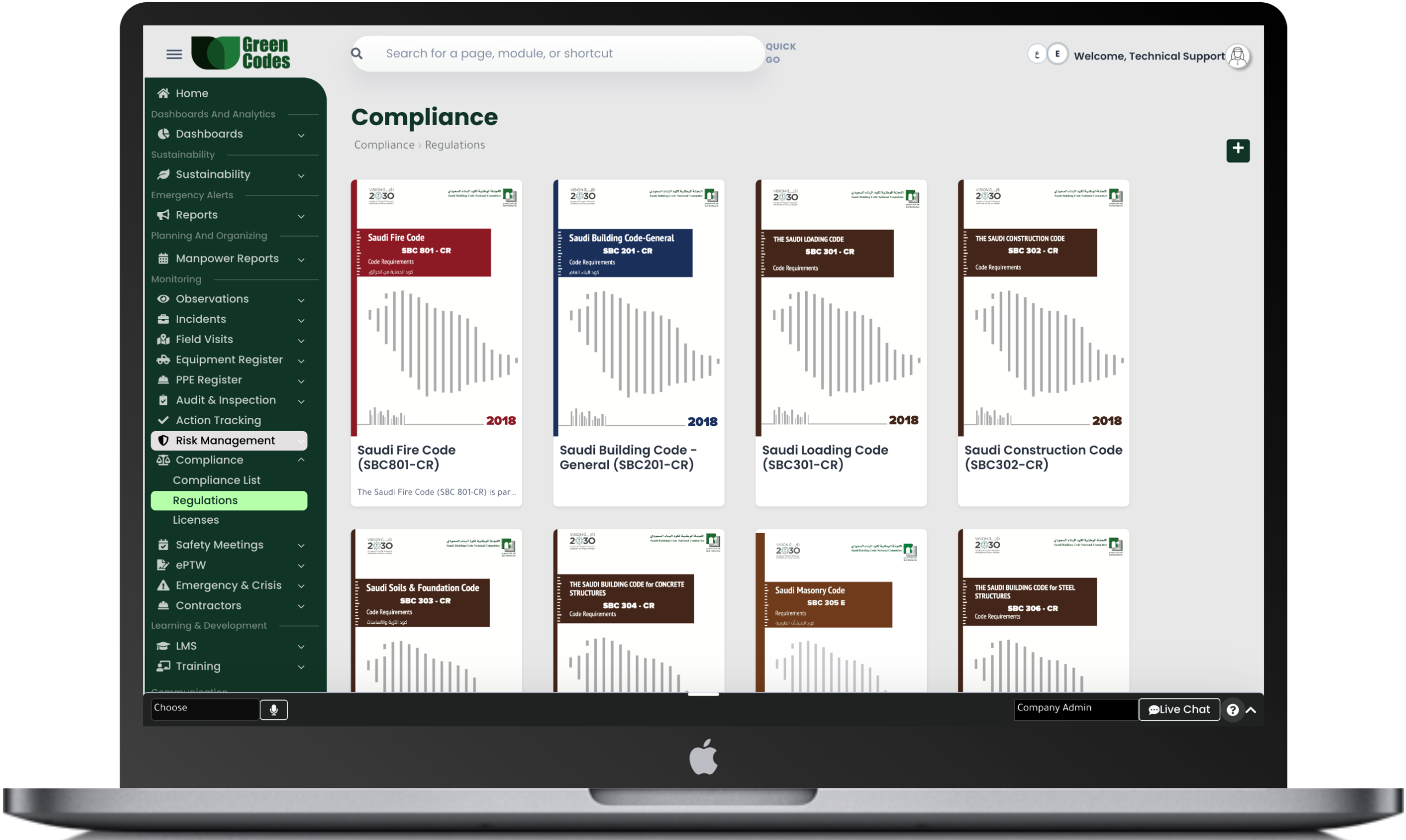
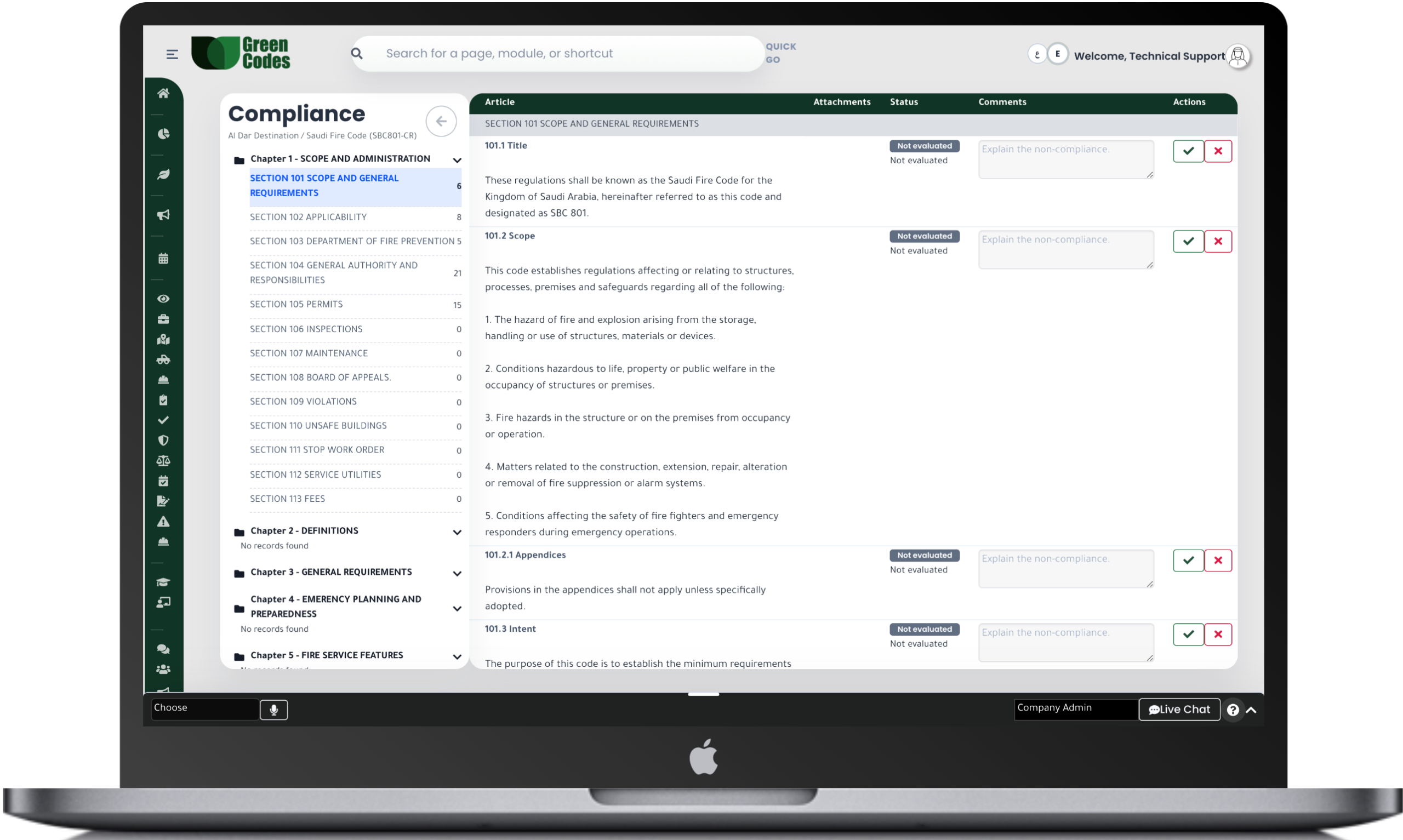
The Compliance Management System within the Green Codes platform provides a complete digital solution for monitoring compliance with approved regulations, laws, and standards across organizations and projects efficiently. It starts with recording regulatory and organizational requirements, followed by tracking the compliance status for each department or project, all the way to implementing corrective actions and closing non-compliance cases. The system enables organizations to manage all compliance requirements easily through the web or mobile application, helping improve governance levels and reduce operational and regulatory risks.
The system also supports linking compliance requirements with internal policies, work procedures, audit results, and inspection findings, helping organizations ensure continuous compliance with local and international standards, as well as safety and quality requirements.
The system provides a comprehensive set of reports and interactive dashboards that help monitor compliance status, such as non-compliance case reports, open corrective actions, compliance percentages by project or department, and periodic assessment reports.
It also offers executive reports that help top management monitor compliance levels, analyze weak points and improvement opportunities, enabling decision-makers to take proactive actions to ensure continuous compliance.
The system follows a clear workflow that starts with recording requirements or regulatory clauses, then evaluating the compliance status and linking it to the relevant site or department. In case of non-compliance, a corrective action is created and assigned to the responsible person for implementation, followed by tracking execution until final closure.
The system also supports automatic periodic reminders for regular reviews, renewal requirements, or reassessment.
Requirement Registration ← Assessment ← Non-Compliance Detection ← Corrective Action ← Review ← Closure
- Non-compliance case management
- Integration with audits and inspections
- Corrective and preventive actions
- Compliance percentage reports
- Periodic review reminders
- Integration with policies and procedures
- Support for local and international standards
- Executive dashboards
Frequently Asked Questions (FAQ)
What is meant by "Compliance Management" within large organizations?
Compliance management involves identifying all obligations—including laws, regulations, standards, and client requirements—then ensuring their implementation, monitoring them, and continuously closing any gaps. Without a clear system, project teams often remain in a “reactive” state during inspections or audits. This module provides a structured framework that links obligations to evidence, corrective actions, and executive reports.
How is a Compliance Obligations Register built?
Every obligation can be entered along with its source, specific article/clause, scope of application (project or facility), responsible owner, and review frequency. You then define the “type of evidence” required, such as a policy, training record, measurement report, or audit minutes. Having this register makes inspections easier because evidence is pre-defined rather than searched for randomly when needed.
How is a compliance assessment conducted and gaps identified?
Periodic assessments can be created to record the status (Compliant / Non-compliant / Needs Improvement) supported by notes and evidence. When a gap is identified, a corrective action is generated with a timeline and an assigned person for execution. This transforms compliance from a simple “Yes/No” into a progressive action program with clear follow-up.
Does the system support Non-Conformance and Corrective/Preventive Action (CAPA) management?
Yes. Since non-conformities may arise from audits, inspections, or incidents, the system allows you to record them, identify the root cause, take remedial action, and prevent recurrence. CAPA (Corrective and Preventive Actions) can be linked to specific compliance clauses or standard items to facilitate proof of closure. Effectiveness can also be tracked later to ensure the gap does not reappear.
How does the compliance module help sectors with special requirements, such as aviation or healthcare?
Sector-specific obligations can be added, such as Safety Management System (SMS) requirements for aviation or infection control and training programs for healthcare facilities. This helps unify requirements across various sites and prevents individual project teams from acting in isolation. Sector-specific compliance reports can also be prepared for review by regulators or accreditation bodies.
How is compliance linked to documents and evidence to facilitate auditing?
Every obligation can be linked to approved documents, such as HSE policies, emergency plans, or training logs. It can also be linked to inspection reports and meeting minutes as proof of implementation. This significantly reduces audit preparation time because evidence is already categorized and stored for each specific obligation.
Does the system provide alerts for periodic reviews and license renewals?
Review dates can be set for specific obligations, such as certificate renewals, re-evaluations, or periodic inspections. Automated alerts are sent before the deadline and can be escalated if not completed. This reduces the risk of operational shutdowns caused by forgetting a renewal or allowing a license to expire.
What executive reports does a Board of Directors need from the compliance system?
The board requires reports on the overall compliance percentage, the number of open and overdue non-conformities, and the top regulatory risks by project or department. Reports can also highlight high-risk obligations that require immediate intervention or additional resources. These reports make compliance “measurable” and support corporate governance.

Carbon Emissions Reduction
The project reduces carbon emissions by over 15,000 metric tons annually, equivalent to planting more than 700,000 trees each year.